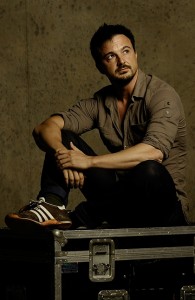
Guillem Clua

Multimedia

Bio

Guillem Clua is a playwright from Barcelona, Spain. He is considered one of the most innovative voices in the Spanish theater scene and part of a new generation of playwrights born in the seventies who are transforming the Catalan stage with their plays. Critics have described his work as multidisciplinary, eclectic, and very much concerned with narrative structure and plot. Storytelling is at the heart of his style, which combines elements of comedy, thriller and melodrama, a vibrant rhythm, and the unabashed influence of other media, such as television and cinema.

Guillem Clua holds a degree in Journalism from the Autonomous University of Barcelona (Spain) and started his theatre training at the London Guildhall University (UK) in 1994. In 2000 he completed his theatre studies in the prestigious Obrador de la Sala Beckett, where he was taught by Jordi Galceran, Enric Nolla, David Plana, Sergi Pompermayer, Martin Crimp and Juan Mayorga, among others.

His first play, INVISIBLES, won the 2002 Theatre Prize Ciutat d’Alcoi, one of the most important awards for new plays in Spain. He also wrote the stage adaptation of Thomas Mann’s DEATH IN VENICE (Sala Muntaner, 2002). In 2004, his play LA PELL EN FLAMES (SKIN IN FLAMES) (Villarroel Teatre, 2005) won the Ciutat d’Alcoi for the second time and the 2005 Critics Choice Award for Best Play of the Year. Its English translation premiered in several American cities as well. Clua is also the author of numerous and celebrated short plays, such as GOLIATH, ANDROMEDA OR DORIS DAY, ENEMY OF THE PEOPLE, presented at the Sala Beckett. In 2006, the playwright moved to New York, where he presented the English version of GUST DE CENDRA (TASTE OF ASHES) at the Spanish Repertory Theatre. His last play MARBURG, the most ambitious so far, premiered at the National Theatre of Catalonia in May 2010, making Clua the youngest playwright that’s ever had the chance to premiere in that venue. His first musical, KILLER, premiered in Barcelona in January 2011 (Sala Muntaner) and transferred to a bigger venue after its run (Villarroel Teatre) due to the great success. Clua is currently working on his last full-length play, LA TERRA PROMESA (PROMISED LAND), a farce about climate change that will be produced in Barcelona in 2012.

In recent years he has worked as scriptwriter for the television series EL COR DE LA CIUTAT(TV3), of which he became the head writer for the 2005/06 and 2007/08 seasons. Clua is currently working for other Spanish TV shows like 90-60-90 and LA RIERA, and is writing the big screen adaptation of his play MARBURG.

Plays

SKIN IN FLAMES (2w, 2m)
Reviews of the premiere production of SKIN IN FLAMES hailed Guillem Clua for his innovative structure and intelligent discourse on media, politics, and war. In 2004, the play was awarded the City of Alcoi Theatre Prize, one of the top theatre recognitions in the country (this marked Clua’s second win of this award, only two years after having received it for his first play INVISIBLES). As of 2010, SKIN IN FLAMES is the most produced (Spain, USA, UK, Greece, Poland, Venezuela, Mexico) and the most unanimously acclaimed play by Guillem Clua.

Frederick Salomon, a photojournalist famous for having captured an image of a girl sent flying through the air after a bomb explosion, returns to the country where he took that infamous photograph twenty years earlier. When he arrives to accept an award, many credit him for the country’s recent peace efforts, but a local journalist, Hannah, has a different interpretation of his image. As Hannah interviews Frederick Salomon, they debate and question the United Nations’ role in aiding third-world nations, the mass marketing of images of violence, and, most importantly, what happened on that fateful day.

Meanwhile, in the same theatrical space, another couple’s story unfolds, although each couple remains unaware of the other’s presence. Dr. Brown makes a routine visit to a local woman, Ida, whose daughter is in a comma at a local hospital. Ida trades sexual favors in exchange for the medical treatment that may save her daughter and the chance to see her little Sara transferred to a hospital in America.

Two contrasting scenes of deceit and desperation slowly shape the plot as the audience pieces together the fragments left behind by war. Who was the girl in the photo? How did that image change her life, her country, and the world? And what was the eventual fall out of each character’s choices?

SKIN IN FLAMES takes audiences on an emotional and intellectual journey, challenging them to consider and question the fine line dividing those in power from those in need of assistance. With an expertly crafted dramatic structure and story elements found in newspaper headlines around the world, Guillem Clua’s award-winning script combines the best of content and form into a hauntingly unforgettable theatrical experience.

TASTE OF ASHES (2w, 3m)
There is a proverb that claims you will never know for certain if a fruit is sweet or bitter until you have bitten into it. That same proverb holds true for the taste of ashes in Guillem Clua’s drama. In Jerusalem, the birthplace of ancient religions, perpetual wars, and millennia-old myths, three American tourists confront the weight of history and their own personal demons. Meanwhile, two young Palestinians bring a secret plan to fruition as a way of giving meaning to a life full of misery.

In the spirit of the acclaimed SKIN IN FLAMES, Western and Eastern worlds passionately collide, forever changing the course of these five people’s lives. This skillfully orchestrated character drama will offer audiences hours of reflection on politics, faith, love, and the taste we all yearn for in our futures.

Prestigious critic Francesc Foguet from El País said about this play: “following the evanescent abstraction of 1990′s playwriting, [in TASTE OF ASHES] we find a globalized thematic specificity. In this context, local theatrical experiences have sharpened the tool, improved techniques, and created a solid basis that makes it possible for Guillem Clua to write a play that could perfectly well have been signed by a British playwright, such as the David Hare of Via Dolorosa”.

MARBURG (4w, 5m)
In August 1967, a virus unknown to humankind broke out in the picturesque German town of MARBURG, rapidly killing 23 people. Ever since, this town’s name has been associated with the virus’ terrible symptoms. This historical event is the first of four stories told in the play. Each story is set in one of four geographical locations that all share the same name: MARBURG.

From the German MARBURG, leaping 14 years into the future, the action transports the audience to Pennsylvania in 1981; the day Ronald Reagan suffered an assassination attempt by John Hinckley, which was also the moment a Republican family lost their only son. We are shown another MARBURG in South Africa, on New Year’s Eve 1999, on the verge of the new millennium. This last story is set in a small chapel where a supposed miracle takes place. And finally, we reach present-day Australia, where two men meet in a meteorological station, thus changing the course of their lives.

The concept of disease, present in all these settings, shapes Guillem Clua’s most ambitious work to date. MARBURG reflects on how disease has played a determining role in different periods of our common imaginary; how it has changed our perspective on life, our environment, and the future; how we react when we feel threatened, when an external element (sometimes as microscopic as a virus) destroys our way of life, or when we are about to vanish from the face of Earth. In short, MARBURG is about the fear of death, and how this fear has assumed on different faces, and different names, throughout the years.

MARBURG has been unanimously acclaimed as an outstanding, ambitious, compact work that transports the audience around the planet and along History with its labyrinthine, surprising, and captivating structure, while posing ethical dilemmas about power, disease, survival, and our attraction to death; an appealing and intelligent look at the lights and shadows of the past century, and the fears and hopes of the new millennium.

MARBURG premiered at the National Theater of Catalonia, in Barcelona (Spain) on May 19th 2010, and it has been translated into English, German, and Greek.

DJ Sanders

Playwright and Translator

DJ Sanders has translated Guillem Clua’s SKIN IN FLAMES (from the original Catalan LA PELL EN FLAMES) and TASTE OF ASHES (from the original Spanish EL SABOR DE LAS CENIZAS), in addition to Àngel Guimerà’s 1896 classic THE LOWLANDS (from the original Catalan TERRA BAIXA). Sanders is also the author of more than twenty original stage plays, including TEMPTATIONS OF THE FATHER, CYPHER: variations on therapy, sex, and baseball, and six ten-minute plays published with Brooklyn Publishers. His works have been presented in Australia, India, and coast to coast in the United States. Sanders previously taught advanced English for non-native speakers at the University of Illinois, the University of Barcelona, and Washington University in St. Louis. He is currently pursuing further graduate studies at Washington University in St. Louis focusing on the translation of drama. He is a member of the Dramatists Guild.

More information on Sanders’ plays and translations is available at http://www.djsanders.com.